How to Take Notes on Poker Hands (and Build a Study Routine)
How to take notes on poker hands: what to write, why memory lies, and a weekly review loop that turns a few hands into steady, consistent poker improvement.
· 12 min read
To take notes on poker hands, write down the situation first (positions, stacks, action, sizes), then your reads and your reasoning, and write the result last. Then review a small batch of those notes every week. That habit, not talent and not the occasional long session of theory, is what produces consistent poker growth.
Most players study in bursts: a video after a bad beat, then nothing for a month. Notes fix that. A written record gives you something to come back to, and coming back is where learning happens. Below: what to write, why memory cannot be trusted, a 30-minute weekly loop, and how to turn notes into reads.
Key takeaways
- Write the situation and your reasoning first. Write the result last.
- Memory favors the big pots and the recent hands. Notes correct that.
- Review three hands a week, not thirty. Finish each review with one written takeaway.
- Notes about opponents are only worth keeping if they change a future decision.
- Stats tell you if a feeling is true, but only over a large enough sample.
Why do notes matter more than hours of study?
Because study without a record does not compound. You learn a concept on Tuesday, forget the spot that taught it by Friday, and repeat the mistake next month.
A written note does three jobs:
- It freezes the decision before the result changes how you feel about it.
- It makes patterns visible. One bad call is noise. The same bad call in five notes is a leak.
- It makes study cheap. Rereading a three-line note takes two minutes. Reconstructing a hand from memory takes ten, and the reconstruction is wrong.
Consistency beats intensity. Thirty minutes a week for a year is 26 hours spent on your own real mistakes.
Why does memory distort poker hands?
Two reasons, and both cost you money.
Results-oriented thinking. You judge a decision by what happened. You called, hit, and won, so the call "worked". You folded and the board bricked, so the fold "was weak". Neither says anything about decision quality. A call can be wrong and still win.
Recency and drama. You remember the last hour and the biggest pots, not the 40 quiet hands where you called too wide from the blinds. Those hands hold most leaks.
This is why the order of a note matters. Write the result first and it colors everything after it. For more on why a real record beats memory, see how to log live poker hands fast.
What should you write down after a poker hand?
Keep it short enough that you will do it. In this order:
- Game and stakes. Cash or tournament, blinds, effective stack in big blinds.
- Positions. Yours and the villain's.
- The action, street by street. Who did what, with sizes. "BTN opens 2.5bb, I 3-bet to 9bb, he calls" is enough.
- Your reads. What you knew about the opponent and why. "Opens wide, folds to 3-bets rarely" is a read. "He seemed weak" is not.
- Your reasoning. What you were trying to do and what range you put him on. This is the most valuable line, and the one most players skip.
- The result, last. Who won and how much. It goes at the bottom so it cannot bias the rest.
- One question. What you are unsure about. This is what you will study.
What does a good hand note look like?
Here is one, written the way you would type it at the table or just after:
$1/$2 cash, 120bb effective. Hero BTN, A♠J♠. CO (loose, calls too much) opens to $7. I call. Flop K♦9♠4♣: CO bets $9, I call. Turn 2♥: CO bets $28 into $35, I fold. Read: CO has shown up with weak kings before and never bluffs the turn. My reasoning: I called the flop with a backdoor flush draw and an overcard. On the turn I had nothing, so the fold felt easy. Question: Should I have 3-bet preflop instead of calling in position against a wide opener? Result: He showed K♣T♣. I would have lost a lot more by calling.
The question at the bottom is your study target. The result sits last, and the note does not say "good fold" or "bad luck". It also hides a lesson: the real mistake may be the preflop call, not the turn fold. You only spot that when you reread with a clear head.
How do you review poker hands each week?
Use a loop with five steps. It fits in 30 to 45 minutes.
- Collect. Gather the week's hands in one place.
- Filter. You do not study everything. Pull out the hands where you were unsure, lost a big pot, or felt something was off. Add two or three quiet, ordinary hands, where hidden leaks sit.
- Study three hands. Three, not thirty. For each, read your note, then re-solve the spot with a clear head: what range does he have, what are the stack depths, what does a solver or a stronger player do?
- Write one takeaway. One sentence, in plain words. "I call too wide from the BTN against late-position opens when I do not have a plan on the flop."
- Apply it next session. Put the takeaway where you will see it before you sit down. Then check your next notes to see if you did.
The loop is boring on purpose. The one-line takeaway gives your next session one thing to watch for.
How do you turn hand notes into opponent reads?
The trap is vague labels like "tricky" or "good player". A useful opponent note is a specific, observed behavior tied to a situation:
- "Never folds top pair to a flop bet, even on wet boards."
- "3-bets light from the blinds against button opens."
- "Overbets river with the nuts and with nothing, rarely in between."
Each one suggests an action. "Seems aggressive" does not.
Two rules keep reads honest. Record what you saw, not what you concluded: "showed 7-2 offsuit after raising UTG" is a fact, "he is a maniac" is a guess. And treat early notes as hypotheses, because one hand is an anecdote.
Can stats confirm or reject a feeling?
Yes, and this is where notes and numbers work together. A feeling like "he never folds to a 3-bet" is a hypothesis. A stat like fold to 3-bet turns it into something you can check.
But sample size matters. You need hundreds of hands on a player before a stat like 3-bet percentage means much, because with 30 hands one hand can swing it wildly.
The same goes for your own game. Feel tight? Check your VPIP. Suspect you give up too often? Check your fold to 3-bet. New to these numbers? Start with what VPIP is and how to calculate it. And if you play live, tracking your stats without a laptop is what makes a real sample possible.
How does Final Table help with hand notes and review?
You can run this routine on paper. It works better when hands, notes and stats live in one place. Here is what the app does today.
Collect. You log hands as you play, and each one is saved to your account. After you finish a hand, a review step lets you star it, add quick tags (Bluff, Value, Mistake, Cooler, Hero Call, Exploit) and type a free-text note. That is your filter step, done while the hand is fresh.
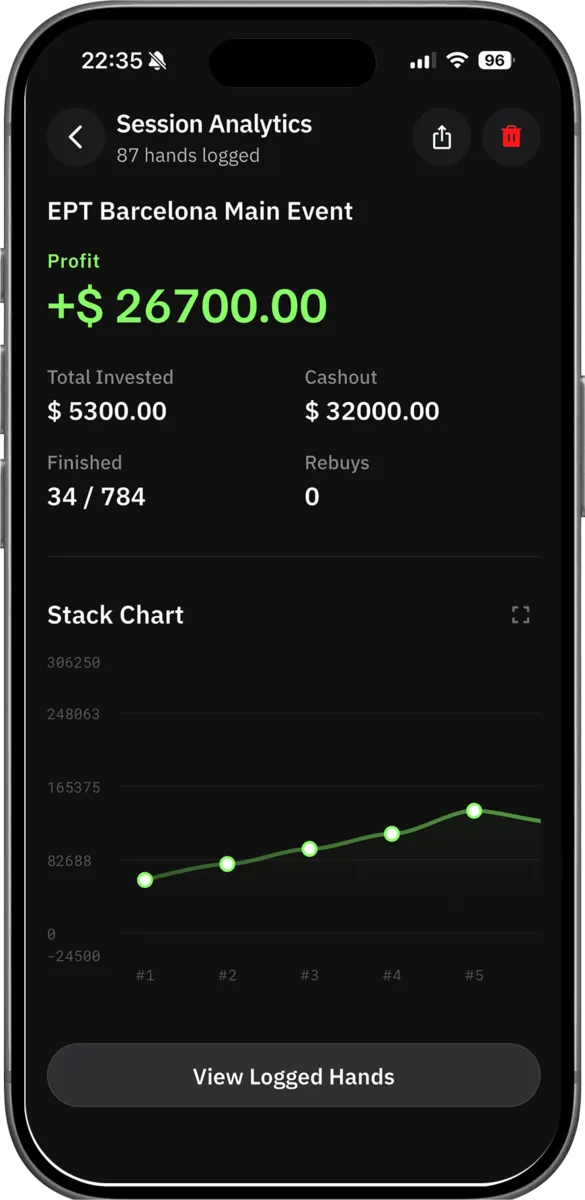
Study. From a session you can open the logged hands and go through any one of them on the hand details screen, which lays the hand out street by street. Starred hands are marked in the list, so your shortlist for the week is easy to find. If you entered your hole cards, you can also ask for an AI analysis of the hand. Treat it as a second opinion next to your own reasoning. To study a hand in a solver, export it in PokerStars hand-history format from the same screen.
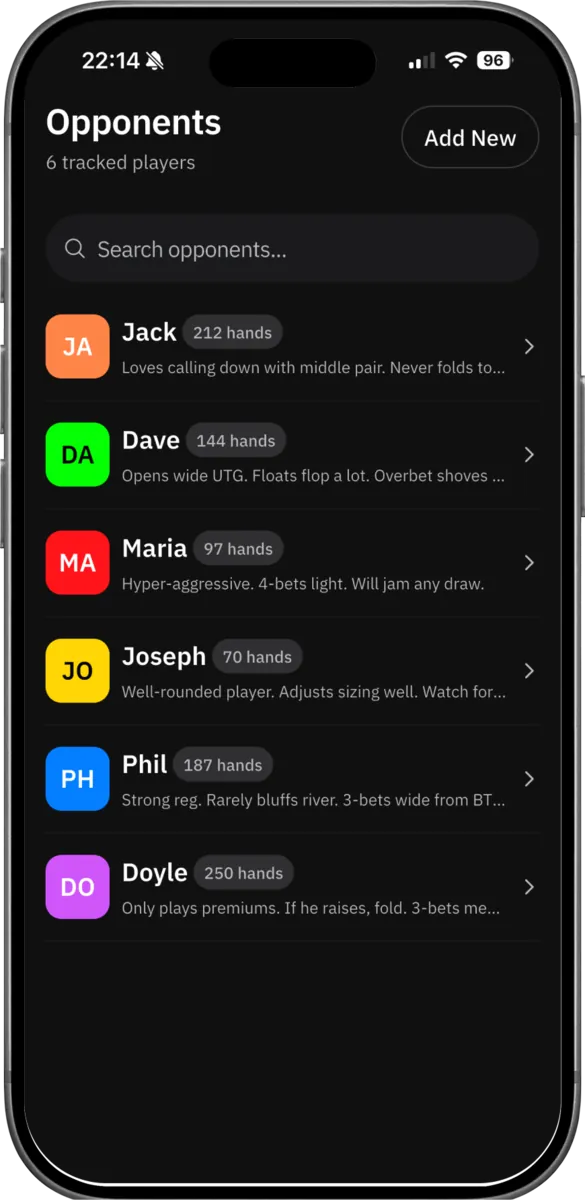
Opponent reads. Every opponent you save gets a profile where you can keep notes, and the app shows stats built from the hands you logged against them. The list shows hand counts, so you can see which reads rest on a real sample.
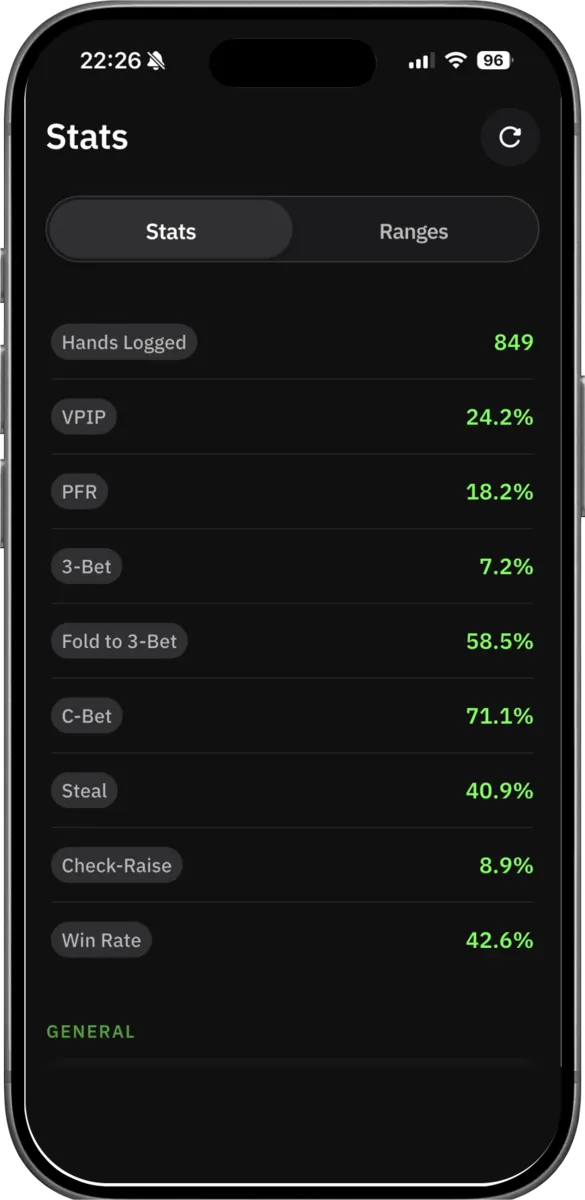
Check the feeling. The Stats screen shows your own VPIP, PFR, 3-bet, fold to 3-bet, c-bet, steal and check-raise numbers, calculated from your logged hands. When your weekly takeaway says "I think I fold too much", this is where you test it.
What if a hand is too fast to log at the table?
This is the gap where most notes get lost. A big pot plays out quickly, the dealer is already pitching the next hand, and you have no time to log every action. By the end of the night the details are gone, and the hand you most needed to study is the one you remember worst.
So we are building flag now, finish later into Final Table. It is rolling out in an upcoming update, and here is how it works.
One tap to flag. During a hand, tap Flag. If you have not entered your hole cards yet, the app asks for them first, because a note without your cards is hard to recognise a week later. You can add up to three tags (Cooler, Bluff, Hero call, Big pot, Mistake, Review), and then the table moves straight on to the next hand. You keep playing.
A snapshot of the table. At the moment you flag, the app saves the table exactly as it was: where the button was, your seat, the blinds and the BB ante, the game type, and every seat with its player, position and stack at the start of the hand (chips already in the pot are added back). This is the part memory gets wrong most often. Hours later you remember the river bet; you do not remember that the villain started the hand with 80 big blinds, not 140.
Finish it when you have time. On the session screen, flagged hands wait in a short list. Each row shows your two cards, the time, your position and your stack in big blinds, so you know at a glance which hand it was. Tap Finish and the app rebuilds that table from the snapshot: same seats, same stacks, same button. You log the actions on a separate copy of the table, so your live session is never touched. When you save, the hand joins your history and your stats like any other hand. If you decide a hand is not worth it, delete the flag; your statistics do not change.
That turns the weekly loop above into something you can do even on a busy night: flag at the table, finish the hands that matter on the way home, then review them on your study day.
Practice between sessions. For a daily habit on top of the weekly review, see how we built the Daily Poker Challenge. Still choosing tools? Read our honest comparison of live poker tracker apps.
Frequently asked questions
How do you take notes on poker hands?
Write the situation first: game, stakes, stacks, positions, and the action with sizes. Then add your reads and your reasoning. Write the result last so it does not bias the rest. Add one question to study. Keep it to a few lines.
How do you log a poker hand later if you had no time at the table?
Save the situation at the moment the hand happens: positions, starting stacks, blinds and your cards. Stacks and positions are what memory loses first. Then fill in the action as soon as you can, ideally the same night. Final Table's upcoming "flag now, finish later" feature does this with one tap: it saves a snapshot of the table and lets you finish the hand from that snapshot later.
How often should you review your poker hands?
Once a week is a good rhythm for most players. Collect the week's notes, pick about three hands worth studying, and write one takeaway. A short review you keep doing beats a long one you abandon.
What poker hands should you review?
Review hands where you were unsure, lost a big pot, or felt something was off. Add a couple of ordinary hands too, because small repeated mistakes cost more than one big pot. Winning hands can hide bad decisions.
How do I stop results from affecting how I judge a hand?
Write your reasoning before you write the result, and judge the decision using only what you knew at that moment. Ask what range the villain had and what the best play was against it. If it still looks wrong ignoring the outcome, it was a mistake. If not, it was variance.
How many hands do you need before poker stats mean anything?
For a stat on an opponent, think in hundreds of hands, not tens. With a small sample, one unusual hand can move a percentage a lot. Use early numbers as a prompt to watch a player more closely, and trust them more as the sample grows.
Final Table puts your logged hands, notes and stats in one place, so the weekly review takes minutes instead of an evening.